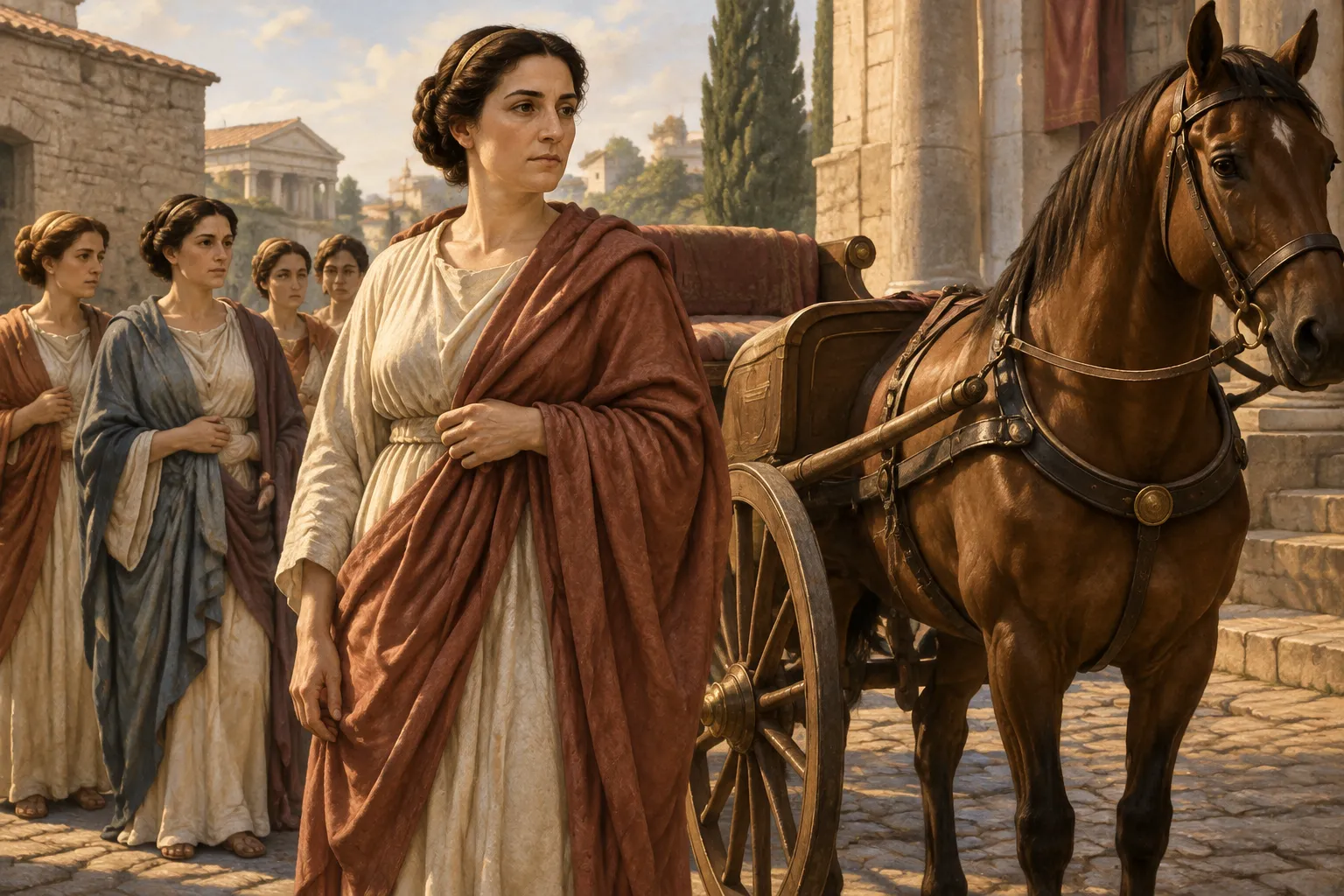
Take away our carriages, and there will be no more children. That is the startling bargain at the heart of one ancient explanation for the worship of Carmenta. In Plutarch’s Roman Questions 56, Roman women answer a restriction on horse-drawn travel by refusing to conceive. Their husbands eventually yield, children follow, and the women establish a temple in gratitude.
It is a memorable story, but what kind of evidence is it? Not a surviving petition, law, or eyewitness account. It is an explanation attached to a religious institution. Read alongside Ovid and another passage in Plutarch, it reveals how a festival could become a story about motherhood, privilege, and the community’s dependence on women.
A carriage dispute at the heart of a festival
Plutarch begins with a question: why were married women credited with founding Carmenta’s temple, and why did they particularly honor it? His answer introduces a reported tale, rather than a documented sequence of events. The senate prevents women from using horse-drawn vehicles. They collectively keep their husbands at a distance until the concession is restored. The temple follows the successful births that mark reconciliation. The wording and sequence of his account matter.
The women do not simply complain about an inconvenience. Within the story’s logic, they withhold the future that their husbands expect them to provide. A dispute over movement through the city becomes a dispute over whether households will continue.
That is an interpretation of the narrative, not proof that Roman women organized such an action. The distinction keeps the story interesting without turning it into a falsely precise historical episode. We can ask what makes the bargain persuasive to its storyteller even when we cannot establish that the bargain occurred.
Nor should we supply missing details. Plutarch does not identify the women, reproduce a decree, or give a date for the confrontation. Calling it a particular historical campaign would make the evidence carry more than it can support.
Ovid tells a darker version
The Roman poet Ovid connects the carriage dispute with Carmenta’s repeated January observance. His Fasti, a poem organized around the Roman calendar, places her rites on January 11 and returns to them on January 15. In Book One, lines 617–636, the loss and restoration of women’s carriage privilege explains the paired celebrations.
Ovid’s version is not identical to Plutarch’s. Rather than describing only abstention from conception, he says women forcibly end pregnancies. His account also includes disapproval of their response. The senate restores the privilege, and the festival arrangement is directed toward renewed childbirth.
That difference changes the emotional weight of the tale. In Plutarch, the action can be read as coordinated refusal followed by reconciliation. Ovid makes the conflict more physically disturbing. A responsible retelling should preserve that difference instead of combining both accounts into a single smooth narrative.
Neither version licenses a general statement that this was how Roman women normally exercised political influence. These are particular literary treatments of a particular religious question. Their shared premise is nevertheless revealing: in each, interference with a female privilege threatens the reproduction of the community.
It is tempting to give that premise a modern political label. More useful is to follow the ancient story’s own outcome. The disagreement ends not merely with restored transport, but with religious observance. Reconciliation becomes something the community can remember through worship.
Why Carmenta was the right goddess for the story
A birth-related dispute needs a deity whose powers make the resolution intelligible. Plutarch supplies one explanation by reporting that some regarded Carmenta as a Fate. In his Life of Romulus, chapter 21, he more specifically associates her with the destiny attending a person’s birth and with worship by mothers.
That association offers a way to understand the carriage legend without reducing Carmenta to a goddess of vehicles. The carriage is the disputed privilege; childbirth provides the religious connection. In this reading, the story joins an everyday object to a larger question about the continuation of families.
Yet Plutarch does not present just one identity for her. In the same chapter, he also preserves a tradition identifying her as an Arcadian prophetess connected with Evander, and discusses competing explanations of her name. His alternatives remain visibly alternatives, rather than steps in a settled biography.
This is especially important on a Roman mythology site. An Arcadian setting belongs to a Greek geographical and legendary framework, but the question being explained here is Roman worship. The presence of Greek connections does not make the festival simply a Greek story with Latin names substituted.
The more careful question is how these writers bring different accounts into contact: a power governing birth, a prophetic woman, and a Roman community explaining its own ceremonies.
Even the family relationship changes
One small discrepancy makes the danger of harmonizing ancient sources particularly clear. In Roman Questions, Plutarch reports that Carmenta was Evander’s mother. In the translation of his Life of Romulus used here, the corresponding alternative calls her Evander’s wife. The difference is present in the chapter’s account of the Carmentalia.
Readers do not need to choose a relationship and erase the other to understand the carriage story. On the contrary, the discrepancy is useful. It warns us that a deity’s supposed life history and the explanations of her cult need not form one consistent narrative.
There is also a difference in what each passage is trying to explain. Roman Questions asks about the temple and married women’s devotion. The Life of Romulus places the Carmentalia within a larger account of Rome’s early community and festivals. The temple question gives the carriage dispute a specific explanatory job.
These are not interchangeable settings. If we detach every detail from its question and assemble them into an encyclopedic biography, we lose the reason each writer introduced it. Keeping the passages separate makes their evidence more, not less, readable.
What the carriage legend can actually tell us
The safest payoff is not that we have recovered a forgotten, datable women’s strike. It is that we can see ancient authors explaining a Roman observance through a conflict over female privilege and childbirth. That conclusion follows from comparing the festival explanation in Ovid with the temple explanation in Plutarch, while retaining their disagreements.
The method is useful elsewhere in the Roman calendar. Our article on why donkeys wore bread at the Vestalia explores another striking detail through the explanations attached to festival practice. The question is not only what people did, but how stories made the practice meaningful.
For Carmenta, the strongest interpretive thread is dependence. The men in the carriage legend can restrict a privilege, but they cannot simply command the desired future into existence. The story makes reconciliation necessary. Its religious ending then places that reconciliation under the protection of a power associated with birth.
Carmenta’s carriages therefore offer something subtler than a colorful anecdote about ancient transport. They show a Roman religious story turning a household expectation into a public vulnerability. We cannot turn the legend into a verified event. We can still recognize the force of its central question: what happens to a community when the women expected to renew it refuse?
Sources and further reading
- Ovid, Fasti, Book One, especially lines 461–542 and 617–636; translated by A. S. Kline.
- Plutarch, Roman Questions 56; translated by Frank Cole Babbitt, hosted by LacusCurtius.
- Plutarch, Life of Romulus 21, in Lives, Volume I; translated by Aubrey Stewart and George Long.


