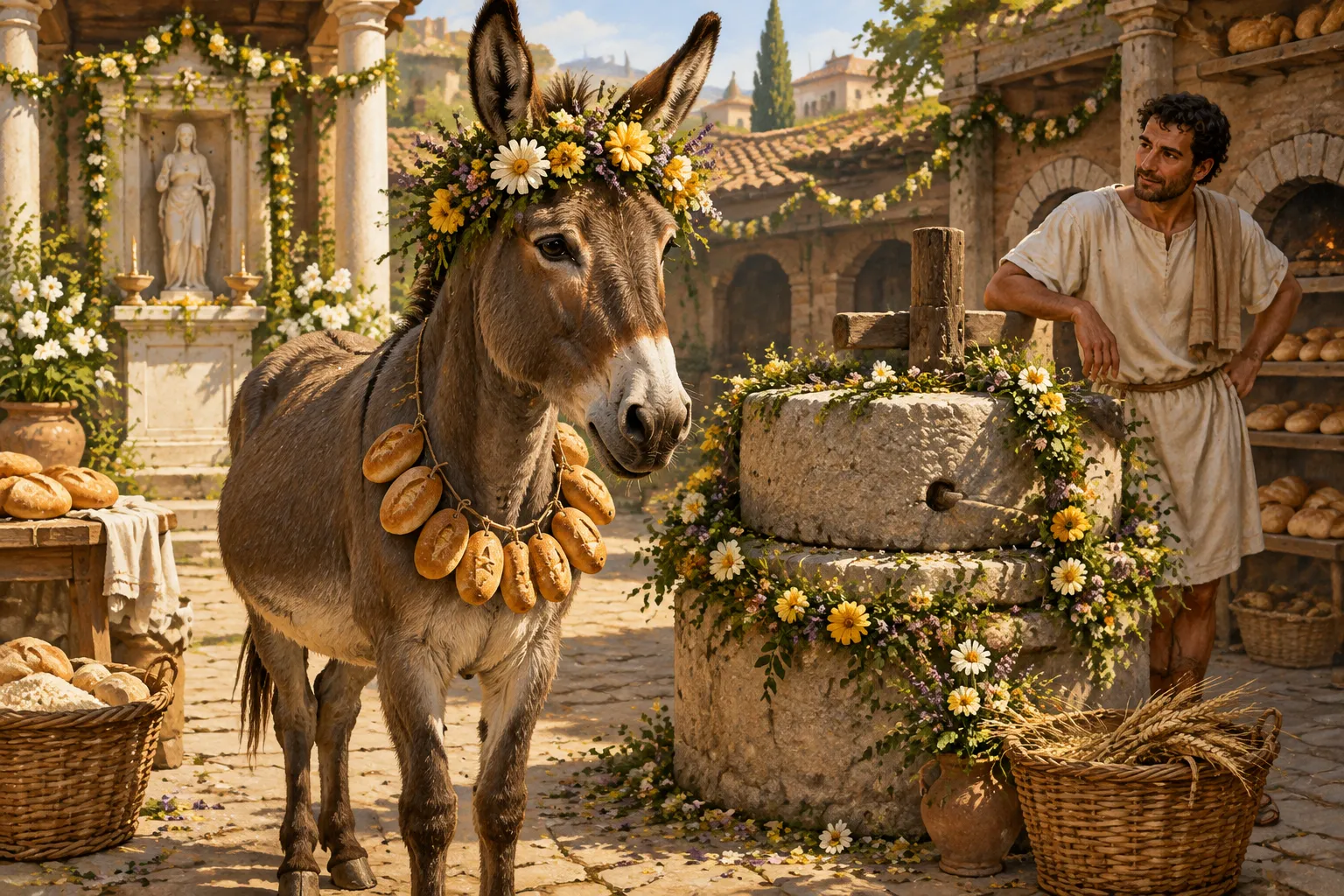
A donkey wearing a necklace of bread is an unexpected image of Roman religion. Yet that is the memorable sight Ovid places in his account of the Vestalia, Vesta’s festival on June 9: working animals are decorated, and flowers cover the millstones. In the June book of his Fasti, bread-making becomes a way into the worship of the hearth goddess.
Why should a donkey receive such attention? Ovid offers both a practical connection and a divine adventure. Reading them together—and comparing his story with another version elsewhere in the same poem—reveals something more interesting than a single tidy explanation. It shows how a Roman poet could make familiar ritual objects tell different stories.
1. A festival seen through Ovid’s poem
Our focus is Rome’s Vestalia as presented in Ovid’s early imperial calendar poem, not a timeless account of everything Romans believed about Vesta. The distinction matters: a poem explaining customs is evidence for ancient interpretation, but it does not automatically establish when those customs began.
The Louvain translation and commentary identifies June 9 as Vesta’s festival and places it within a period, June 7–15, when women could enter her sanctuary. Its notes connect the final day with ritual sweeping. That wider setting helps explain why the festival cannot be reduced to its most picturesque animal custom.
For this particular question, however, we should keep our attention on the bread and millstones. What is being decorated, and why? Those questions let us follow Ovid’s reasoning without treating every detail of his religious storytelling as a literal historical report.
They also give a useful reading rule: distinguish the custom he describes from the explanation he supplies. A garlanded millstone and a tale about a divine banquet are different kinds of evidence, even when a poet places them side by side.
2. The straightforward answer: donkeys helped make bread
In Fasti 6.305–318, Ovid moves from food offered at the hearth to decorated animals and milling equipment. He explicitly connects the baker’s reverence for Vesta with the she-ass that turns the millstones. His description also recalls bread baked beneath hearth embers. The sequence linking hearth, baker, and mill animal supplies an explanation before the myth begins.
Read this way, the decorations acknowledge a chain of work. Bread does not appear merely because someone lights a fire. Grain must be processed, dough prepared, and heat applied. In Ovid’s arrangement, the goddess of the hearth belongs within that chain rather than standing apart from it.
This is an interpretation of the passage, not proof that every participant understood the ceremony identically. Its strength is that it follows the objects Ovid himself selects. The loaf points toward nourishment; the millstone toward preparation; the donkey toward the effort that makes preparation possible.
The contrast between a rough working surface and a flower garland is particularly effective. Something useful becomes something honored. We need not imagine a spectacular procession or invent elaborate ceremonies to appreciate that transformation: the decorated equipment is already a striking religious image.
3. The dramatic answer: a bray protects Vesta
Ovid then changes register. In Fasti 6.319–348, Cybele hosts a divine gathering, and Vesta falls asleep. Priapus approaches her intending sexual assault. Silenus’s donkey brays, waking the goddess and bringing the company rushing over; Priapus escapes. Ovid closes by linking Vesta’s gratitude to the animal’s bread ornaments and the cessation of milling. The annotated text of the episode makes this explanatory connection explicit.
The story should not be softened into a failed romance. The sleeping goddess has not consented. Although Ovid introduces the episode with a playful tone, its action concerns a threatened violation. We can recognize the literary comedy directed at Priapus without adopting his perspective.
As an explanation of the festival, the tale changes the donkey’s significance. In the preceding passage, the animal deserves recognition because it works. Here, it deserves recognition because it has protected the goddess. The same decoration can therefore express both usefulness and gratitude.
Notice, too, that the animal does not need a speech or a carefully devised rescue plan. Its ordinary noise defeats the stealth of a god. My reading is that this mismatch gives the episode much of its narrative force: the apparently unimpressive creature becomes decisive, while the would-be aggressor loses control of the scene.
4. Why the other version matters: Lotis, not Vesta
The warning against taking this as a single fixed tradition comes from Ovid himself. In Book One, lines 391–440, he tells a closely related story about Priapus and the nymph Lotis. The setting is a celebration of Bacchus in Greece. Again, Silenus’s donkey interrupts Priapus’s approach to a sleeping victim. Lotis rises and escapes, and the exposed god becomes an object of laughter.
That version explains why a donkey is sacrificed to Priapus. Its narrative destination is punishment, not Vesta’s grateful decoration. The repeated bray leads toward opposite ritual outcomes: an animal can be remembered as an enemy by the frustrated aggressor or as a benefactor by the person it protects.
This is a useful example of adaptation within a Roman literary work. Book One explicitly gives its festival a Greek setting; Book Six employs the related plot to explain a custom associated with Rome’s Vesta. Calling both episodes simply “the Greek myth of Hestia” would erase the distinction between the named figures, settings, and purposes of the two passages.
Nor does the repetition prove which version came first outside the poem. It establishes something narrower and firmer: Ovid presents both, and their differences matter. The Louvain commentary likewise draws attention to the parallel Lotis episode. Readers should preserve that variation rather than merge the stories into a supposedly definitive account.
5. What the bread necklace can—and cannot—tell us
The safest answer to our opening question has two parts. Ovid connects the honored donkey with bread production, and he also tells a rescue story that gives its honors a memorable divine cause. His passage supports both readings; it does not require us to choose one and discard the other.
We should resist a further leap: neither explanation, by itself, dates the beginning of the custom. An origin story explains why a practice makes sense within a narrative. That is not the same task as reconstructing its earliest historical development.
This distinction also sharpens how we read the site’s broader discussion of ritual and ceremony in Roman epic narratives. Here the question is especially concrete: how does storytelling attach meaning to an object used in religious celebration?
The bread necklace offers a compact answer. It joins ordinary labor to divine protection without making them identical. Looking first at the mill animal, then at Vesta’s rescuer, we can see the poet building meaning around the same visible decoration. The payoff is not a hidden secret of Roman worship, but a better way to read its surviving stories: attend to the objects, identify the narrator, and allow different explanations to remain different.
Sources and further reading
- Ovid, Fasti, Book Six, translated by A. S. Kline; especially 6.305–348.
- Boxus and Poucet, translation and commentary on Fasti 6.249–468, Bibliotheca Classica Selecta; French translation with explanatory notes.
- Ovid, Fasti, Book One, translated by A. S. Kline; especially 1.391–440 for the Lotis version.


