
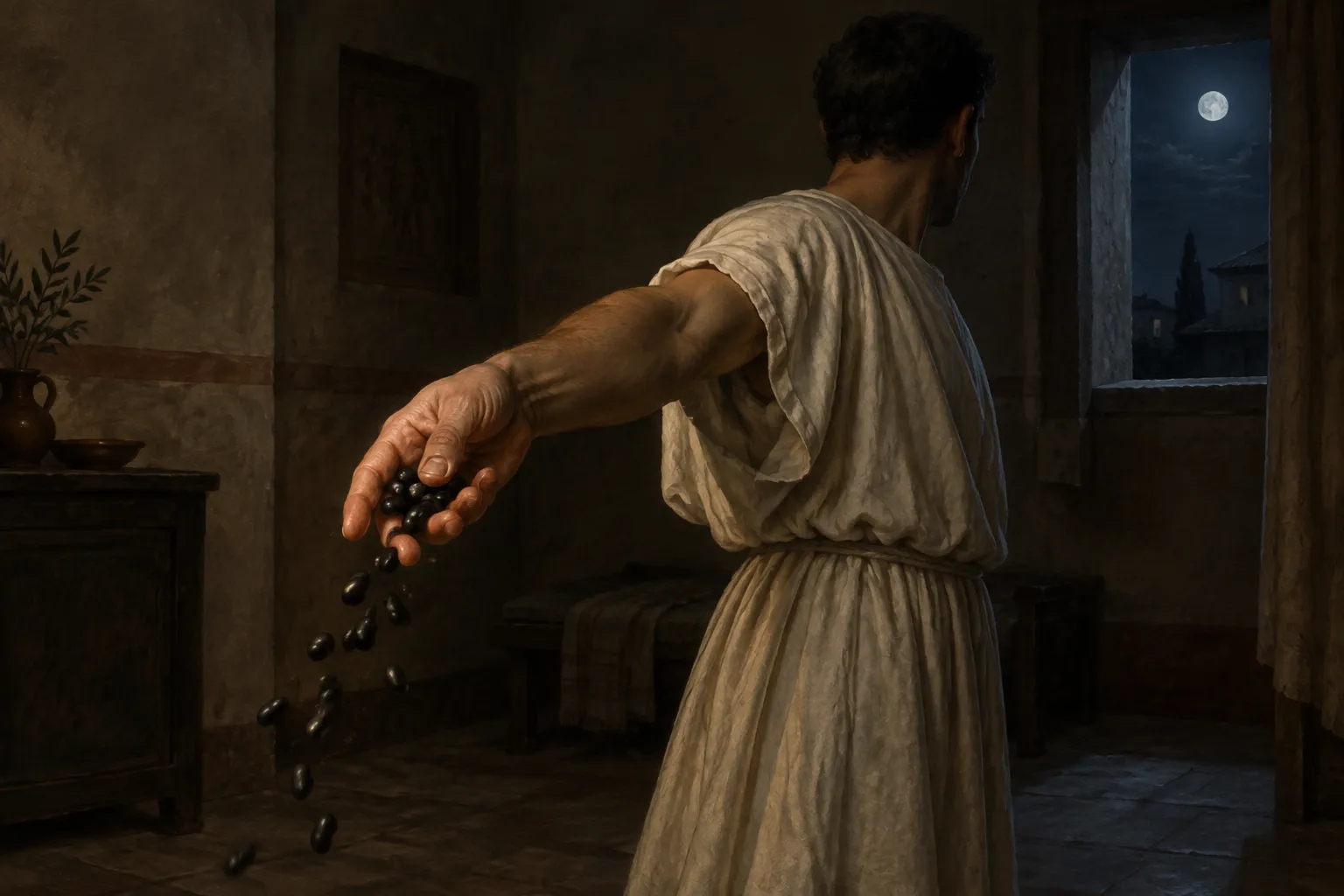
At midnight, a Roman worshipper throws black beans behind him without looking back. Something unseen is supposed to collect them. The gesture is not simply feeding a visitor: it purchases safety for the living. That is the unsettling scene in Ovid’s description of the Lemuria in Book Five of the Fasti, his poem about the Roman calendar.
Why beans? The most honest answer is narrower than many modern explanations suggest. Ovid tells us what they accomplish within the ceremony, but does not explain why this particular food has that power. His account offers something more interesting than a tidy superstition: a household negotiates with its dead, then insists that they leave.
A midnight exchange, not a ghost hunt
In Book Five, lines 419–444, the worshipper makes a protective hand gesture, washes with spring water, and casts black beans with his face averted. He repeats a declaration of redemption nine times. The shade is imagined gathering the beans unseen. After touching water again and sounding bronze, he repeats a dismissal nine times, then looks back.
Read as a sequence, the ceremony resembles a controlled exchange. First comes protection; then an offering that separates the worshipper and his people from danger; finally, an instruction that the visitor depart. This is an interpretation of the actions, not a claim that Ovid supplies a formal theology of ghost removal. Still, it helps explain why the beans cannot be reduced to a snack for supernatural guests.
The distinction matters. Hospitality ordinarily invites someone to remain. Here, giving and departure belong together. The offering makes a boundary possible rather than dissolving it. The living person does not win by fighting the ghost or proving that it exists. Success means completing the prescribed actions and being able to turn around.
That last movement gives the episode its unusual tension. For most of the ceremony, the worshipper must act without checking what is happening behind him. To a reader, the withheld glance makes the invisible visitor feel close. Yet this literary effect should not be confused with eyewitness evidence: we are reading a poet’s account of a rite, not observing an ancient household ourselves.
What the beans explain—and what they do not
The central distinction is between a ritual’s stated purpose and an explanation of its materials. Ovid connects the beans with redemption. That supports describing them as a substitute payment within his narrative. It does not establish why beans, rather than another offering, were selected, or why their dark colour mattered.
It is tempting to fill that gap with a confident symbolic formula: black means death, beans contain souls, therefore ghosts demand black beans. But a satisfying chain of associations is not automatically the explanation of this particular Roman ceremony. The passage leaves room for questions that it does not answer.
For the same reason, the number nine should be reported before it is decoded. Repetition plainly structures the scene; a universal theory of what nine meant would require additional evidence. A careful reading can notice precision without pretending that every precise detail comes with an available explanation.
This makes the Lemuria a useful lesson in reading ancient religion. Knowing how a rite was described is not identical to knowing its origin. We can understand the ceremony’s dramatic logic—offer, protect, dismiss—while remaining uncertain about the earlier history of its ingredients. That uncertainty is part of the evidence, not a defect to be repaired with invention.
Were these enemies or ancestors?
A helpful comparison comes from another Roman observance in the same poem. In his February account of the Feralia, Book Two, lines 533–570, Ovid recommends modest gifts at tombs: grain, salt, bread soaked in wine, and violets. He says devotion matters more than expense. Yet he also recounts a story in which neglected ancestral rites lead to wandering spirits and deaths, until the omitted honours are restored.
That February passage complicates a neat division between affectionate ancestors and frightening ghosts. Within Ovid’s storytelling, respect and danger can belong to the same relationship. The dead need not become an entirely different species of being before neglect has consequences.
One possible reading is that these scenes concern obligations more than personalities. Asking whether a ghost is inherently “good” or “evil” may be less useful than asking whether the relationship between living and dead has been properly maintained. This does not erase differences between festivals; it cautions against turning those differences into an inflexible supernatural classification.
The comparison also changes the emotional texture of the beans. A dismissal need not imply hatred. Living people can acknowledge a claim without granting unlimited access to their home. In that reading, the ceremony is neither pure affection nor pure terror. It is the uncomfortable work of honouring a relationship while setting limits to it.
Remus returns to ask for remembrance
Ovid next gives the festival a foundation story. In Book Five, lines 445–480, Remus appears to his grieving foster parents, Faustulus and Acca, and asks for commemoration. Romulus complies. Ovid presents an earlier name, Remuria, as becoming Lemuria. This is the poem’s explanation of the name, not independent proof of the festival’s historical origin.
The narrative’s emotional premise deserves attention. Remus has lost his place among the living, but still asks for a place in their memory. Read alongside the household ceremony, his request suggests a distinction between allowing the dead to remain physically present and refusing to forget them. Departure and remembrance need not be opposites.
For the circumstances of his death, the relevant witness is Ovid’s own April narrative in Book Four, lines 835–856. Romulus orders Celer to protect the new boundary. Remus jumps across it, and Celer kills him with a shovel. Romulus initially conceals his grief, then mourns openly at the funeral.
This is therefore not simply the familiar shorthand of Romulus personally striking down his brother. Keeping the named version clear makes the May episode easier to understand. Ovid’s Remus can condemn Celer while preserving affection for Romulus. The later ghost story revisits a wound already narrated within the poem rather than introducing an unrelated haunting.
A boundary the living must maintain
There is a suggestive parallel between the two episodes: the city’s boundary is crossed with fatal consequences, while the household ceremony seeks to restore a boundary between living and dead. That is a literary interpretation, not evidence that the bean ritual developed directly from the wall-building story. The distinction prevents an attractive reading from hardening into an invented history.
The same caution applies to treating the Fasti as a transparent instruction manual. Its descriptions, speeches, and origin stories need to be read as different kinds of material. A narrated procedure can preserve valuable religious evidence without making a divine explanation or legendary genealogy historically demonstrable.
For another tightly focused example of ordinary materials acquiring festival meaning, see why donkeys wore bread at Rome’s Vestalia. The useful question in both cases is not merely what an object symbolized, but what people were said to do with it.
For the Lemuria, the reader’s payoff is that practical distinction. The beans do not answer every question about Roman beliefs concerning ghosts. They make a particular transaction possible in Ovid’s account. The dead receive recognition; the living recover their distance. What makes the scene memorable is the demand that both things happen together.
Sources and further reading
- Ovid, Fasti, Book Five, especially lines 419–492: the Lemuria ceremony and Remus’s appearance.
- Ovid, Fasti, Book Two, especially lines 533–570: offerings to ancestors and the consequences of neglect.
- Ovid, Fasti, Book Four, especially lines 835–856: Celer’s killing of Remus and Romulus’s mourning. All three translations are by A. S. Kline.


